
Cross-Border Guide · HZMB
The Complete HZMB Cross-Border Charter Guide
A 55 km sea crossing that draws Hong Kong, Zhuhai and Macao into a one-hour living circle. How to ride the Golden Bus, how many times you clear immigration, whether a charter means changing vehicles, what the toll costs: one guide covers it all, so you can take the family across with ease.
01 · Meet the bridge
One bridge, three places: Hong Kong to Macao in 42 km
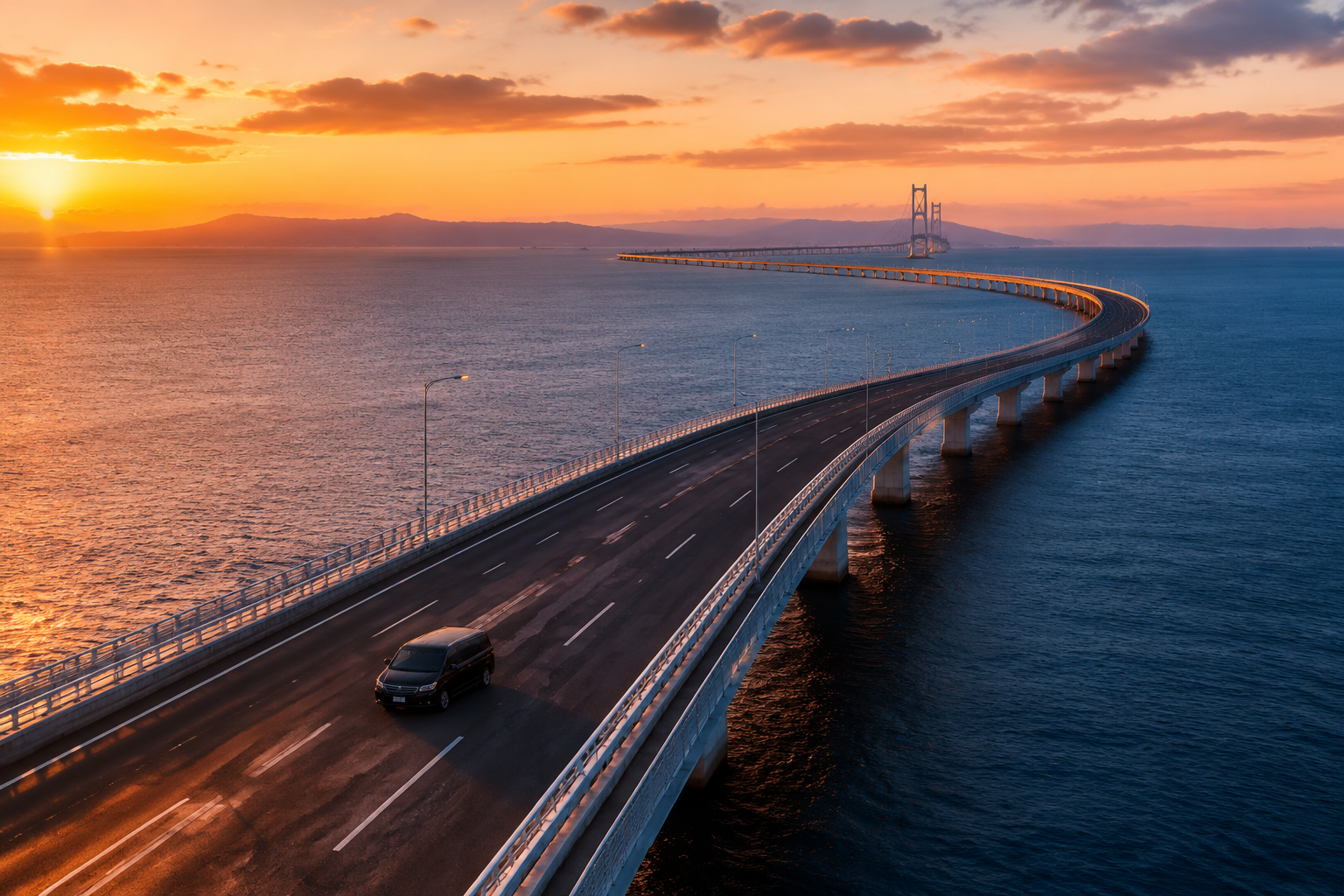
The HZMB runs 55 km in total, made up of three sections: the Hong Kong link road (12 km), the main sea-crossing bridge (29.6 km) and the Zhuhai link road (about 13.4 km). It is currently the world's longest bridge-tunnel sea crossing. From the Hong Kong port to the Zhuhai or Macao port, the drive is about 42 km.
The bridge opened on 24 October 2018, and the ports run 24-hour clearance. The main bridge sits in mainland waters, with three lanes each way and right-hand driving throughout, which is why cross-boundary vehicles switch to mainland road rules once they leave Hong Kong. The Hong Kong port stands on a man-made island northeast of Hong Kong International Airport at Chek Lap Kok on Lantau, reachable by car via the North Lantau Highway, Shun Long Road or the Tuen Mun-Chek Lap Kok Link.
In one line
If your destination is Zhuhai or Macao, the HZMB is usually the most direct overland choice; if it is Shenzhen or the eastern shore of the Greater Bay Area, ports like Shenzhen Bay or Huanggang may suit you better. Settle on where you are going first, then decide which bridge and which port to use.
02 · Clearing the border
"Three ports, three checks": two clearances per crossing
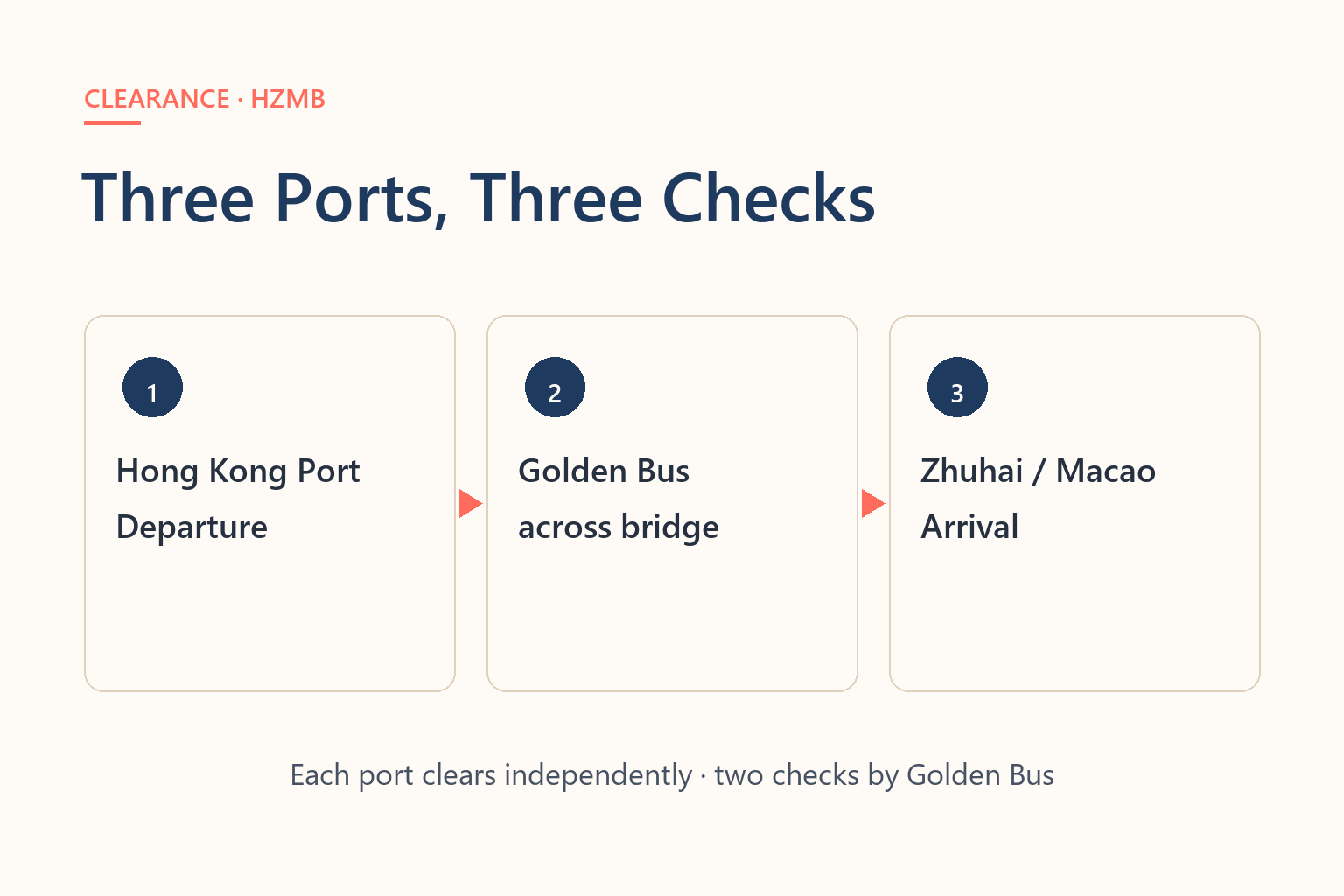
Many people assume the bridge works like co-location at West Kowloon high-speed rail. It does not. The HZMB uses "three ports, three checks": Hong Kong, Zhuhai and Macao each clear independently.
Shuttle bus (Golden Bus) passengers clear departure at the Hong Kong port, board the bus across the bridge, then clear arrival at the Zhuhai or Macao port: two clearances in all. Hong Kong residents with a smart ID card can use the e-Channel self-service gates. From 25 June 2026, eligible Hong Kong permanent residents can register for the "contactless e-Channel", clearing departure on facial recognition as they walk through, with no need to show a document (you still carry your ID card).
03 · The Golden Bus (shuttle)
The only public link across the bridge: the Golden Bus
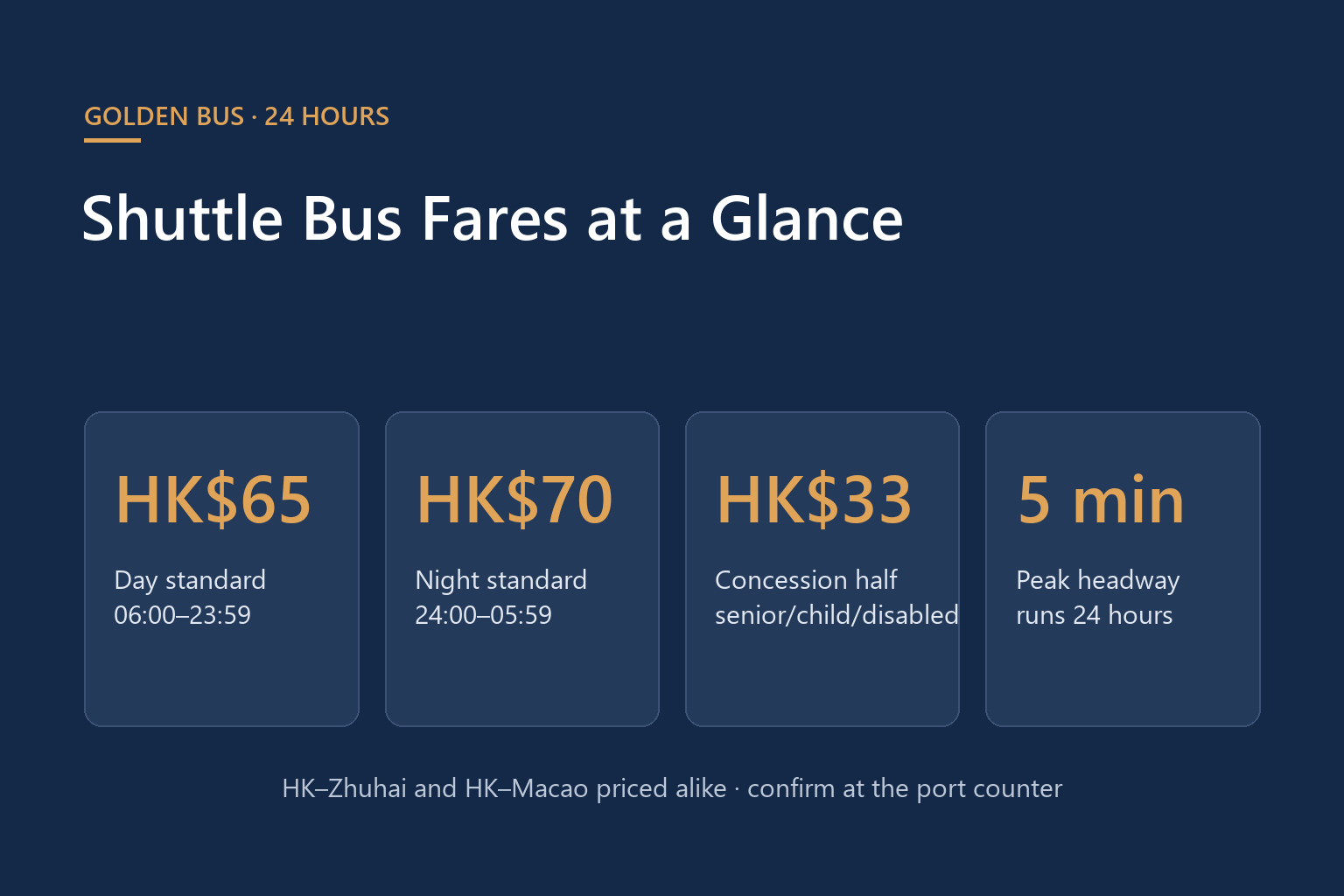
The Golden Bus is the public shuttle across the bridge. The Hong Kong-Zhuhai and Hong Kong-Macao lines share one fare and run 24 hours. The table below shows the fares published at the Hong Kong port ticket office; the actual counter price applies.
| Ticket type | Day 06:00–23:59 | Night 24:00–05:59 | Who it covers |
|---|---|---|---|
| Standard | HK$65 | HK$70 | General adult |
| Concessionhalf price | HK$33 | HK$35 | Children under 12 or below 1.2 m, persons with disabilities, seniors 65+ |
Frequency: 24 hours, every 5 minutes at peak, 10–15 minutes off-peak, 15–30 minutes overnight. Tickets: counters and self-service machines inside the restricted area of the passenger clearance building, or buy online in advance. The official journey time is not fixed; the drive alone runs about 35–45 minutes, and with clearance at both ends usually 1.5–2 hours (industry estimate).
04 · How a charter crosses
The charter's biggest upside: straight through, no vehicle change
A quota-holding cross-boundary hire car (the "dual-plate" charter) or a cross-boundary through-coach takes you straight from urban Hong Kong to a set point in Zhuhai or Macao. You clear at the Hong Kong port en route, but you do not get out to change vehicles. The Golden Bus, by contrast, means transferring at the port and hauling your own luggage across. With elders, children or heavy bags, that gap matters.
The main-bridge toll is charged per vehicle per trip: RMB150 for a small passenger car, RMB200 for a large coach; the free-flow electronic lane (Unitoll) gives a 5% discount. The toll is payable only in RMB cash or by designated e-payment (Alipay, WeChat, MPay) and bank card (UnionPay / Master / Visa / Amex / JCB). Note that Autotoll has not been usable for the bridge toll since 16 March 2026.
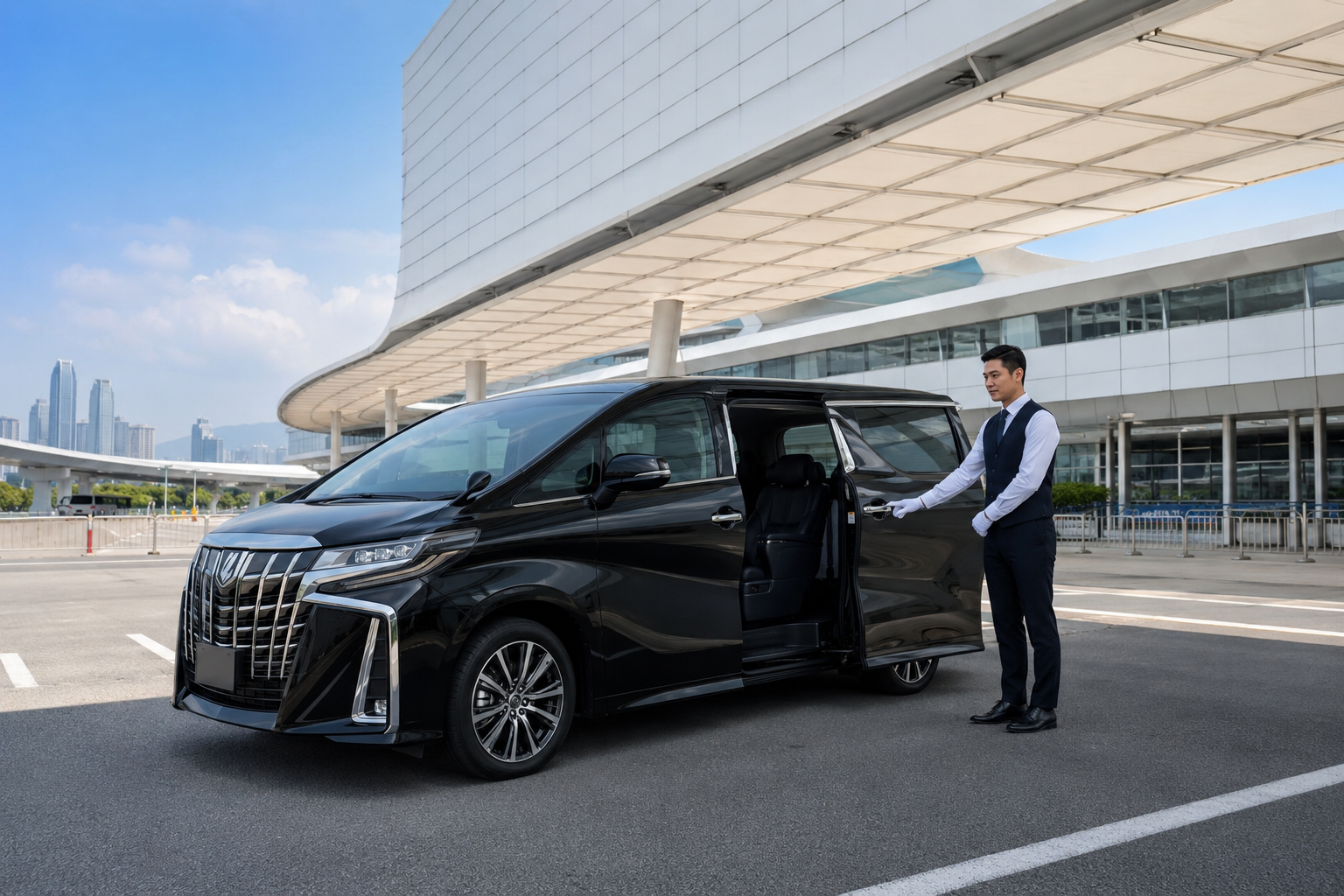
Taking the whole family across, the tiring part is not the drive: it is dragging luggage between ports to transfer. A charter cuts that out.
How to spot a legal charter
Look for the hire-car permit on the lower-left windscreen, plus the bilingual "Cross Boundary Hire Car / 跨境租賃汽車" labels with a unique number on the front and rear. Verify via the Hong Kong Transport Department's online checker, or call the hotline 2804 2600. Never use an unlicensed private car to cross the border.
05 · Choosing among three ways
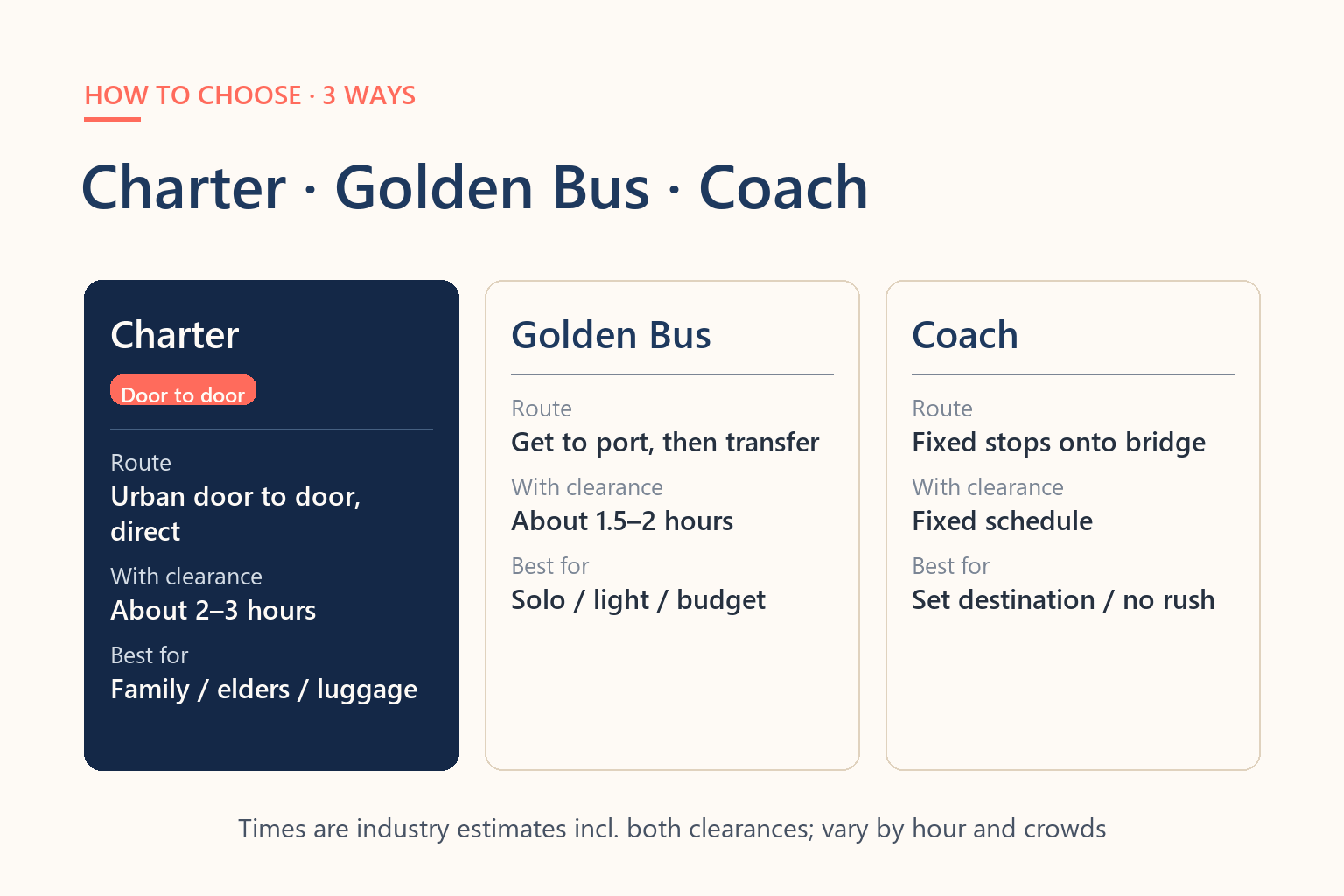
Charter · Golden Bus · through-coach: which suits you
| Option | Journey | Time incl. clearance | Flexibility | Best for |
|---|---|---|---|---|
| Cross-border charterdoor to door | Door to door in town → bridge → set point in Zhuhai / Macao | About 2–3 hours (est.) | Highest: point to point, carries luggage, stops on request | Families, elders, heavy luggage, business, sharing among several |
| Golden Bus + transfers | Make your own way to the HK port → Golden Bus → destination port → local transport | 1.5–2 hours (est.) | Medium: reach the port yourself, transfer, two arrivals | Budget-conscious, solo with light luggage, flexible departure |
| Cross-border through-coach | Fixed urban stop → bridge → Zhuhai / Zhongshan / Macao hotels | Fixed schedule | Medium-low: set points, set times | A fixed destination, mid-range budget, no rush |
| Ferry (not via bridge) | HK-Macau / China-HK terminals → Macao / Zhuhai | About 1 hour sailing | Medium: subject to schedule and weather | Near a terminal, prefers the traditional route (for comparison) |
Times are industry estimates including clearance at both ends, and vary with the time of day and port crowds. The ferry does not use the bridge and is shown only for comparison.
The easy choice
With elders or children
Pick the charter. No hauling luggage to transfer at the port, and the driver can stop along the way for a rest or the toilet; the business MPV's sliding door makes boarding easy.
The budget choice
Solo / light luggage
Pick the Golden Bus. 24 hours, every 5 minutes at peak, HK$65 by day, most flexible: you just have to reach the port yourself and transfer.
The middle ground
Fixed destination
Pick the through-coach. From a fixed urban stop straight onto the bridge to hotels in Zhuhai / Zhongshan / Macao, at a mid-range price, ideal for a set itinerary and no rush.
06 · Before you set off
Before the bridge, sort these out
Travel off-peak and book early on holidays
Over long weekends and festivals, the bridge ports and feeder roads get very busy, and the Transport Department urges travelling off-peak and planning ahead. Lunar New Year even brings a limited toll waiver: from 15 to 23 February 2026, passenger cars of 7 seats or fewer cross the bridge to and from Zhuhai / Macao free of the RMB150 toll. Traffic is heavier on these days and charter slots tighter, so book well ahead.
Documents and the e-Channel
Smart ID residents can use the e-Channel self-service gates, and Hong Kong residents are exempt from the arrival/departure card. Mainland elders bring their Exit-Entry Permit with a valid endorsement, and overseas travellers their relevant travel documents.
Payment and parking
The bridge toll takes only RMB or designated e-payment / bank card, so it is easiest to have e-payment ready. If you self-drive and switch to the Golden Bus, car parks 1–5 at the Hong Kong port offer 673 private-car spaces (including 12 accessible bays); booking online is advised.
Elders and children
The passenger clearance building at the Hong Kong port has dedicated arrival counters for seniors (65+) and persons with disabilities, accessible toilets and a baby-care room. On child seats, the bridge authority lists no specific cross-boundary rule; in practice the carrier's policy and the current laws on both sides apply, so tell us your child's age and height when booking a charter.
07 · FAQ
Cross-Border Crossing FAQ
How long is the HZMB and which places does it link?
It runs 55 km in total (12 km Hong Kong link road + 29.6 km main bridge + about 13.4 km Zhuhai link road), connecting Hong Kong, Zhuhai and Macao. It is the world’s longest bridge-tunnel sea crossing, opened on 24 October 2018, with 24-hour clearance at the ports.
How much is the shuttle bus (Golden Bus)?
Hong Kong–Zhuhai and Hong Kong–Macao share the same fare: daytime (06:00–23:59) standard HK$65, night (24:00–05:59) HK$70; concessionary fare (children under 12 or below 1.2 m, persons with disabilities, seniors 65+) is half price, i.e. HK$33 day / HK$35 night. Confirm at the port ticket counter.
How frequent is the Golden Bus? Is there an overnight service?
It runs 24 hours: every 5 minutes at peak, 10–15 minutes off-peak, and 15–30 minutes overnight.
Is crossing the bridge "co-location"? How many times do I clear immigration?
No. The bridge uses "three ports, three checks": each of the three ports clears independently. Golden Bus passengers clear departure at the Hong Kong port, board the bus, then clear arrival at the Zhuhai or Macao port, two clearances in all.
Chartering across the bridge to Zhuhai/Macao, do I change vehicles? What is the toll?
A quota-holding cross-boundary hire car or through-coach runs straight from urban Hong Kong with no vehicle change (you clear at the Hong Kong port but stay with the car); the Golden Bus requires a transfer at the port. The main-bridge toll for a small passenger car is RMB150 per trip (5% off via the free-flow electronic lane), payable only in RMB or by designated e-payment / bank card.
How do I tell a legal cross-boundary charter?
Look for the hire-car permit on the lower-left windscreen and the bilingual "Cross Boundary Hire Car / 跨境租賃汽車" labels with a unique number on the front and rear. Verify via the Transport Department online checker, or call the hotline 2804 2600.
Should I plan ahead on holidays? Is there ever a toll-free window?
Ports and feeder roads are busy on long weekends and festivals; the Transport Department advises travelling off-peak and planning ahead. There is a Lunar New Year toll waiver: 15–23 February 2026, passenger cars of 7 seats or fewer cross the bridge to/from the Zhuhai/Macao ports free of the RMB150 toll.
HZMB charter
Want to take the family across the bridge with ease?
Tell us your Hong Kong pickup, your destination and your party size, and we will recommend the smoothest port and the right vehicle for your trip. A licensed dual-plate car goes straight through, with no hauling luggage to transfer at the port.
 Add me on WeChat
  WhatsApp